I visited the Paphos Archaeological Park while I was in Paphos attending AAMAS 2026 in Cyprus. Inside the park, I explored the House of Dionysus — initially thought to be a royal residence, but with the discovery of a palace nearby, historians now believe it belonged to a wealthy collector or someone of considerable importance. It is an exceptionally rich villa, with floors almost entirely covered in stunning mosaic artwork depicting mythological, vintage, and hunting scenes. My guide walked me through some really wonderful Greek myth stories illustrated right there in the mosaics.
I’ve been drawn to Greek mythology for a while now, mostly for three reasons:
(i) So many of the stories we know and love today are retellings or reimaginings of these ancient tales. (ii) These stories carry truths that still hold up today — and not the comfortable kind. They don’t deal in simple morals like “do good and good will follow.” Instead, they sit with something harder and more honest: that you can do everything right and still suffer, that life is indifferent to your intentions. It’s a far cry from the tidy, triumphant endings we grew up with in Disney films, and honestly, it feels more real for it. (iii) Christopher Nolan is making The Odyssey, and consider this my homework for that.
This blog is a collection of 5 Greek myths for you to read in your free time. I find them fun, engaging, and a perfect companion for a slow afternoon. So settle in and enjoy.
Outline
- The Story of Apollo and Daphne
- The Story of a Poor Farmer
- The Love Triangle
- The Narcissist
- The Forbidden Love
The Story of Apollo and Daphne
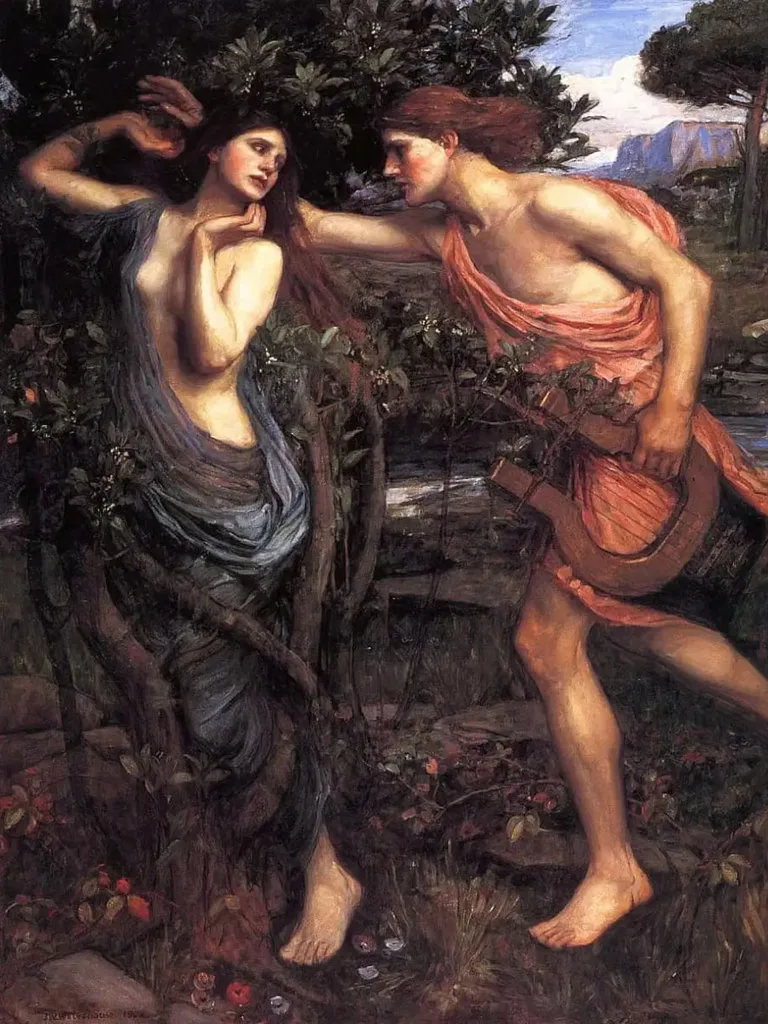
Apollo and Daphne, proof that love can destroy you
Characters:
- Apollo: The Greek god of light, music, and poetry (shown standing on the left/top, leaning forward).
- Daphne: A beautiful nymph who swore a vow of eternal chastity (center).
- Peneus: The river god and Daphne’s father, depicted lounging at the bottom wearing a crown of reeds and holding a cornucopia (horn of plen).
- Eros also known as Cupid in Roman myths. He has small arrows with him.
Right before this story begins, Apollo was feeling incredibly arrogant. He had just slain the monstrous Python with his bow and arrows. Flush with victory, he ran into Eros, who was also carrying a bow. Apollo mocked the smaller god, essentially saying, “Leave the archery to real men, boy. Your little arrows can’t do anything compared to mine.”
Eros, furious at being insulted, decided to teach Apollo a lesson in humility. He flew to the top of Mount Parnassus and drew two different arrows from his quiver, each with a completely opposite magical property:
- The Gold Arrow: Tipped with a sharp, gleaming golden point. Anyone struck by this arrow would be consumed by an instant, uncontrollable, and relentless love for the first person they saw.
- The Lead Arrow: Tipped with a blunt, heavy lead point. Anyone struck by this arrow would instantly feel a deep, visceral revulsion and hatred toward any romantic advances.
Eros shot Apollo with the golden arrow, causing him to instantly fall madly, obsessively in love with Daphne.
At the exact same time, he shot Daphne with the lead arrow, ensuring that she would find the very idea of Apollo’s love absolutely repulsive.
After the god Apollo fell relentlessly in love with Daphne, she rejected his advances and fled. He pursued her in a frantic chase. Just as Apollo was about to catch her, Daphne cried out to her father, Peneus, for help. Peneus answered her prayer by transforming her into a laurel tree. If you look closely at the mosaic, you can see her feet and lower legs transforming into tree roots and bark.
The Story of Dionysos
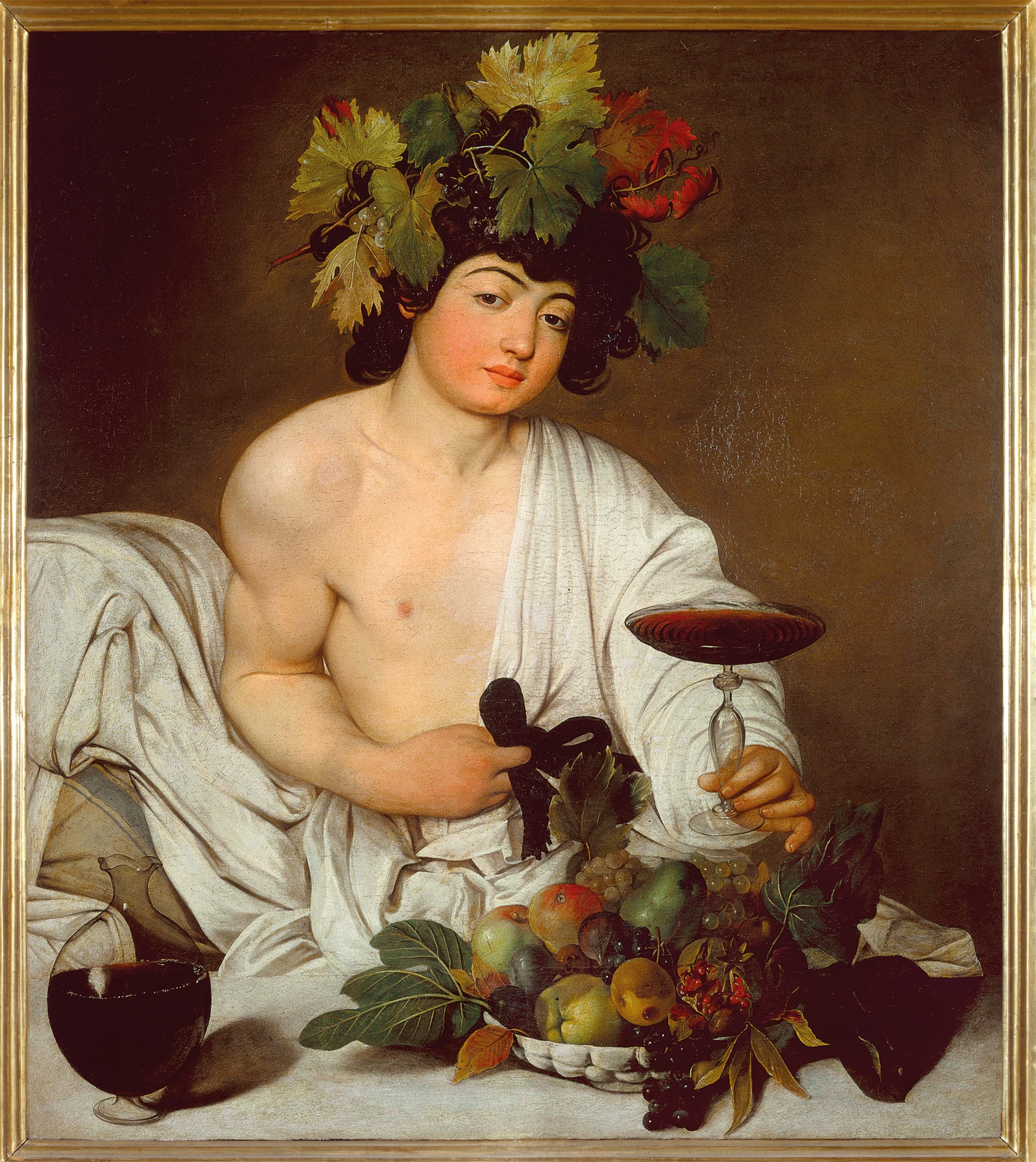
Dionysos, I become this when I drink wine
Characters:
- Dionysos: The god of wine.
- Ikarios (or Icarios): A tragic Athenian farmer.
In Greek mythology, Dionysos left his divine home to travel the mortal realm specifically to introduce humanity to viticulture (the cultivation of grapevines) and the art of winemaking.
Unlike many other gods who visited Earth to punish mortals or pursue romances, Dionysos came bearing a direct gift. Wine was completely unknown to humans at the time. He wanted to teach mankind how to farm grapes, ferment them, and enjoy the divine beverage he championed.
When he arrived in Athens, an elderly farmer named Ikarios extended warm hospitality and hosted the traveling god. To express his gratitude for this kindness, Dionysos decided to make Ikarios the very first mortal to learn the secret of wine.
He taught Ikarios how to cultivate grapes and make wine. Excitedly, Ikarios loaded a cart with wineskins to share this magical drink with local shepherds. However, the shepherds had never experienced alcohol before; when they became deeply intoxicated, they assumed Ikarios had poisoned them and murdered him. It is one of mythology’s earliest cautionary tales about overindulgence.
The Love Triangle
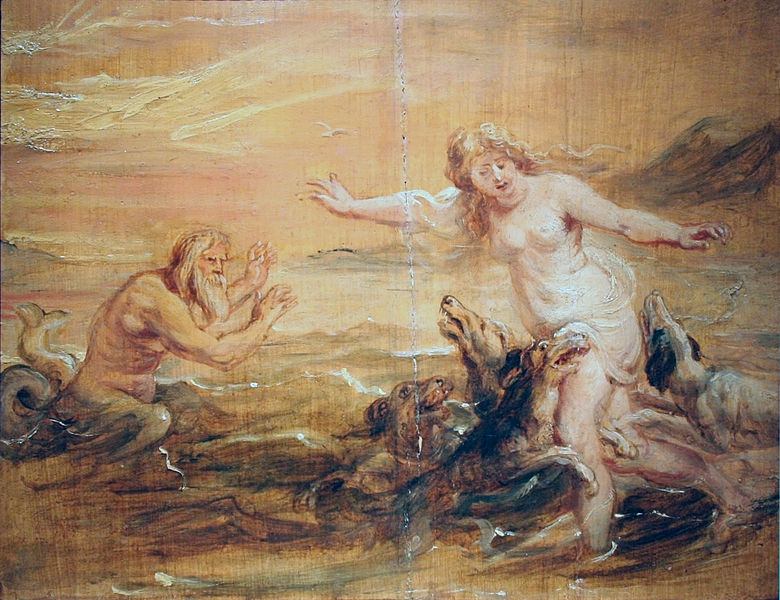
Scylla, Glaucus, and Circe — the original love triangle that birthed a monster
Characters:
- Scylla: Originally a breathtakingly beautiful and gentle sea nymph who loved wading in coastal tide pools.
- Glaucus: A mortal fisherman who underwent a mystical sea-change into an immortal sea god after consuming a magical herb.
- Circe: The legendary and powerful sorceress/witch of the island of Aiaia.
Originally, Scylla was a remarkably beautiful nymph who loved nothing more than walking along the seashore and wading in the tide pools. Because of her beauty, she had many suitors, but she rejected them all, preferring to live undisturbed.
One day, a sea god named Glaucus saw her swimming and fell madly, obsessively in love with her. Glaucus hadn’t always been a god; he was originally a mortal fisherman who had eaten a magical herb that transformed him into an immortal being of the sea, complete with a fish-tail and a beard green as seaweed.
When Glaucus approached Scylla to declare his love, she was absolutely terrified by his strange, half-man, half-fish appearance and fled up a steep cliff where he couldn’t reach her.
The Bitter Witch
Heartbroken and desperate, Glaucus traveled to the island of Aiaia to seek the help of Circe, the powerful witch of Greek myth. He begged her to mix him a love potion or cast a spell that would make Scylla return his affection.
However, things backfired completely. When Glaucus explained how beautiful and perfect Scylla was, Circe fell in love with Glaucus instead.
Circe told Glaucus to forget about the mortal girl who rejected him and offered herself to him. But Glaucus refused, famously declaring that trees would grow at the bottom of the ocean and seaweed would grow on mountaintops before his love for Scylla ever faded.
The Revenge and Transformation
Furious at being rejected for a mere nymph, Circe directed all of her rage and jealousy at Scylla.
She brewed a terrifyingly potent poison using dark, magical herbs. Circe then flew to the coast of Italy where Scylla loved to swim. She found a quiet, secluded bay where Scylla regularly sought shelter from the heat of the sun to bathe in the cool water.
Circe poured the dark potion directly into the pool, polluting the water with her malice, and muttered a series of horrific curses over the waves.
The Horrific Moment
Later that day, Scylla arrived at the pool and waded in up to her waist. Suddenly, she looked down and was horrified to see ferocious, barking dog heads bursting directly out of her own thighs and waist.
At first, she thought she was being attacked by wild beasts and tried to run away or push them off, but she quickly realized the monsters were a part of her own body. The poison had permanently fused them to her flesh, warping her lower half into a mass of snapping jaws and a coiled, scaly serpent’s tail.
The Aftermath
Driven mad by her horrific transformation and the cruelty of the gods, Scylla fled deep into the ocean. She took up residence in a dark cave on one side of a narrow maritime strait, right opposite the deadly whirlpool monster Charybdis.
Miserable and full of hatred for all living things, she spent eternity taking her revenge on any sailors who passed by — including Hercules, Jason and the Argonauts, and Odysseus — using her snapping hound heads to snatch men right off the decks of their ships.
It’s a tragic reminder in Greek mythology that the monsters aren’t always born monsters; sometimes, they are just caught in the crossfire of the gods’ petty drama.
The Narcissist
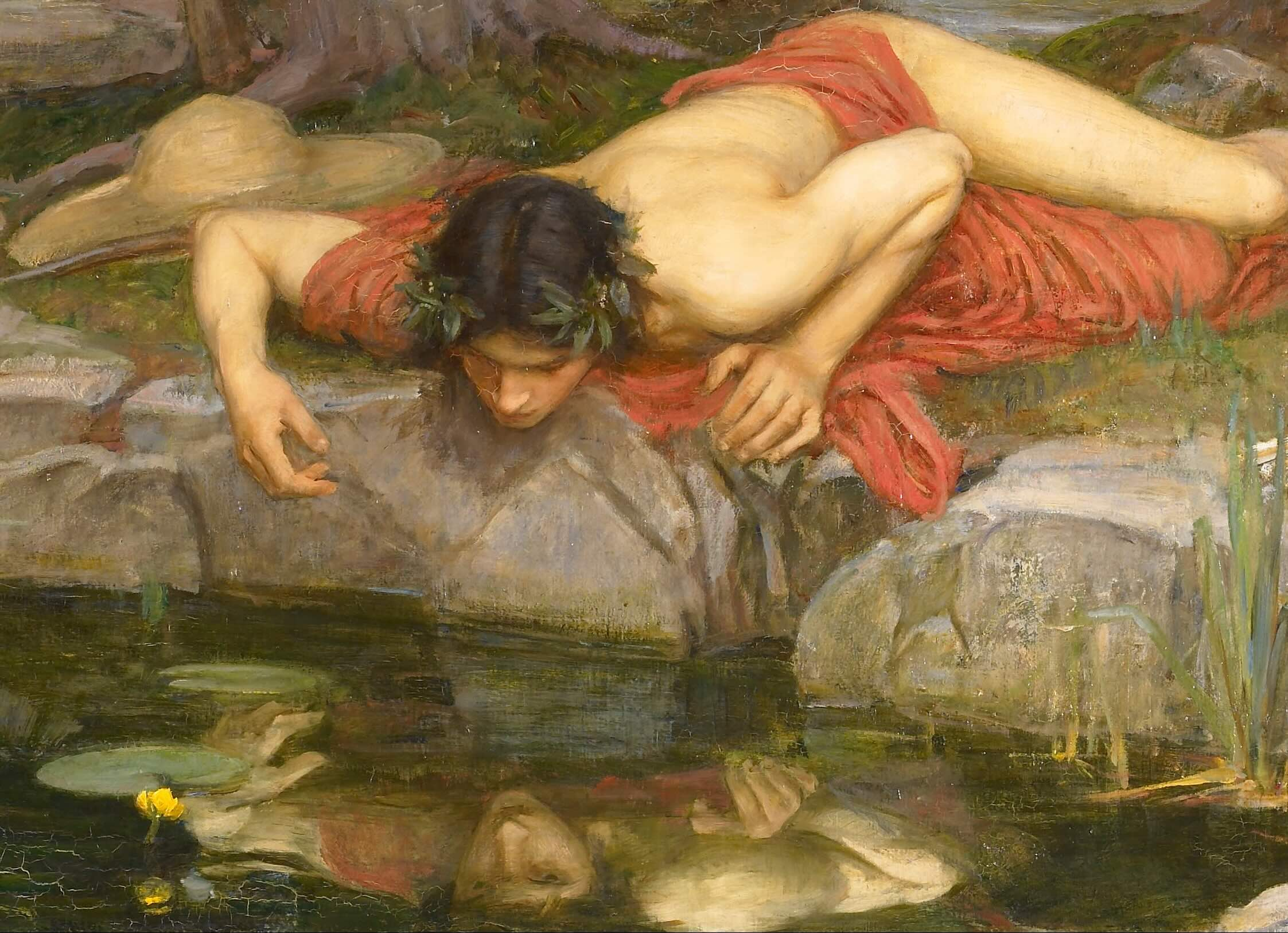
Me gazing at my own reflection in mirror
Narcissus was born the son of a river god and a nymph, and he possessed a beauty so extraordinary that almost everyone who saw him — man, woman, mortal, or god — instantly fell in love with him.
However, Narcissus was completely incapable of loving anyone back. He was intensely proud, arrogant, and cold. He brutally rejected every single person who tried to show him affection, leaving a trail of broken hearts behind him wherever he went.
The most famous of his rejected suitors was a mountain nymph named Echo. Echo had been cursed by the goddess Hera to never speak her own words; she could only repeat the last few words that someone else had just spoken.
One day, Echo spotted Narcissus hunting in the woods and fell deeply in love, trailing him silently through the trees. When Narcissus heard rustling leaves, he called out:
- Narcissus: “Is anyone here?”
- Echo: “…here!”
- Narcissus: “Come!”
- Echo: “…come!”
Thinking someone was playing a game, Narcissus yelled, “Let us join together!” Echo, overjoyed, rushed out from the trees with her arms wide open to embrace him.
Narcissus took one look at her, pushed her away in disgust, and shouted, “I would die before I let you touch me!” Heartbroken and deeply humiliated, Echo fled into the caves of the mountains. She wasted away from grief until her body disappeared completely, leaving behind nothing but her voice — which is why we still hear an “echo” in lonely places today.
The Divine Punishment
After Narcissus rejected yet another suitor, an anonymous lover prayed to Nemesis, the goddess of retribution and divine vengeance. The prayer was simple: “May he who loves not others finally fall in love, and may he never possess the object of his desire.”
Nemesis decided that Narcissus’s cruelty had gone too far and granted the prayer.
She led an exhausted, thirsty Narcissus to a hidden, pristine pool of water deep in the forest. The pool was perfectly still, acting like a flawless mirror. As Narcissus bent down to take a drink, he saw his own reflection in the water for the very first time.
The Final Trap
He was instantly transfixed. Not realizing he was looking at himself, Narcissus fell madly, obsessively in love with the beautiful “water spirit” staring back at him.
He tried to kiss the image, but his lips only met cold water. He reached into the pool to embrace the youth, but the moment his fingers touched the surface, the water rippled and the beautiful face shattered into pieces. He waited for the water to clear, and the face returned, staring back at him with the same intense longing.
Narcissus could not tear himself away. He forgot to eat, he forgot to drink, and he refused to sleep. He lay by the edge of the pool for days, weeping and staring into his own eyes, consumed by a burning desire for a love that could never love him back.
Eventually, rooted to the spot by his own obsession, Narcissus wasted away and died of starvation and sorrow. When the nymphs came to retrieve his body for a funeral, his corpse was gone. In its place, growing at the water’s edge, was a brand new flower with white petals and a golden center — the Narcissus flower (which we commonly call the daffodil).
The Forbidden Love
Pyramus and Thisbe grew up in the ancient city of Babylon. They lived in connected houses and were deeply in love, but their parents strictly forbade them from marrying or even seeing each other.
Desperate to communicate, the lovers discovered a tiny, hidden crack in the shared brick wall between their houses. For months, they would press their lips against the cold bricks, whispering sweet words and planning a way to be together.
Eventually, unable to bear the separation any longer, they hatched a secret plan to escape their homes under the cover of night. They agreed to meet outside the city walls at a well-known landmark: a white mulberry tree standing right next to a cool spring.
The Encounter with the Lion
Thisbe, slipping out of her house unnoticed, arrived at the mulberry tree first. As she sat waiting under the silver moonlight, a terrifying lioness emerged from the nearby woods to drink from the spring. The lioness’s jaws were dripping with fresh blood from a recent kill.
Terrified, Thisbe bolted for a nearby cave to hide. As she ran, her silk veil slipped off her shoulders and fluttered to the ground near the tree.
The lioness finished drinking, noticed the abandoned veil on the ground, and playfully mauled and tore it apart with her bloody jaws before wandering back into the forest.
The Tragic Misunderstanding
A short while later, Pyramus arrived at the meeting spot. He looked down and froze in horror:
- He saw the deep, fresh footprints of a lion in the dirt.
- He found Thisbe’s veil, completely shredded and soaked in fresh blood.
Pyramus instantly jumped to the worst conclusion. He assumed that the love of his life had arrived early and been brutally slaughtered by a wild beast. Overwhelmed by agonizing guilt for not being there to protect her, he cried out, “A single night shall destroy two lovers!”
He drew his sword, held it tightly against his chest, and plunged it into his own heart. As he fell, his blood spurted high into the air, staining the white berries of the mulberry tree a deep, dark red.
The Double Tragedy
Moments later, Thisbe cautiously crept out of the cave, still trembling but eager to see Pyramus. When she reached the tree, she was confused because the berries were no longer white, but a dark purple-red.
Then, she saw Pyramus gasping his last breath on the ground. She rushed to his side, cradling his body and crying out his name. Hearing her voice, Pyramus opened his heavy eyes one last time to look at her, and then died in her arms.
Recognizing her blood-soaked veil and his empty scabbard, Thisbe realized exactly what had happened. She pulled the bloody sword from her lover’s chest, placed the tip against her own heart, and fell upon the blade.
The Fun Fact / Connection: According to the myth, the gods were so moved by the couple’s tragic devotion that they permanently changed the color of the mulberry fruit. To this day, mulberries ripen into a dark, blood-red color as an eternal memorial to the tragic love of Pyramus and Thisbe.