This blog proposes a simple criterion for distinguishing good people from bad people. The answer, I have come to realize, is not complicated at all.
Setup
Consider two running examples: (i) A cheating wife who gets caught, and her husband gets hurt. (ii) A rude boss who mistreats their employees, and the employees get hurt.
Thesis: Both these people are bad.
For the longest time, I resisted judging people. A couple of years ago, I would have said there is more nuance to this — maybe they had reasons for why they acted a certain way.
The Rationalization Problem
Here is my mental model:
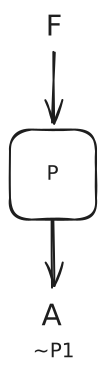
Here, F represents the force (e.g., the wife might have unmet needs; the boss might have stress from leadership), P is the person/actor (the wife/boss), A is the action they took (cheating / being rude to employees), and ~ represents hurting someone — in this case, P1.
If you talked to the wife or the boss, they would both give you reasons for what they did. The wife has unmet needs and hence cheated. The boss has pressure from leadership and hence was rude. In both cases, they had clear reasons for why they acted a certain way. So are they wrong after all?
Claim 1: The existence of a reason does not justify the action.
This is where intellectually minded people go wrong. We try to stand in their shoes, steelman their behaviour: “Oh yes, they had their reasons.”
But humans are rationalization machines. They are remarkably good at giving reasons for why they acted a certain way, and — very conveniently — their reasoning always lands on the action they already took. This is called motivated reasoning: reasoning with the intention of arriving at a predetermined conclusion. Moreover, for any action, there is always a reason, so there is always a “why.” That alone does not mean the action was correct or that the person is good. Hence: I don’t care about the why.
The Fork: Alternative Actions Always Exist
If you think more carefully, the actor almost always has the option to act differently.
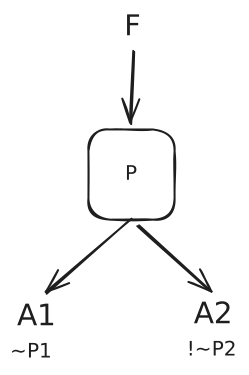
Given the same force F, there are two pathways leading to actions A1 and A2 — one in which person P1 is hurt (~P1) and another in which P1 is not affected (!~P1).
Claim 2: Good people choose the path that does not cause harm. Bad people choose the path that does.
This is the simple but elegant truth. We have seen it in every movie — a villain is someone who hurts others; a good person does not. Unlike the movies, it is not that hard, in my opinion, to be good.
Note: this claim assumes that a non-harmful alternative action exists. I am not talking about tragic dilemmas where every available option causes harm to someone. I am talking about everyday choices where a harmless path clearly exists and the person chooses the harmful one anyway.
Weaker Claim (Conjecture): The path that hurts others is often the easier one. I don’t have hard evidence for this, but in our running examples: it is far easier for the boss to lash out than to manage his stress; it is much harder for the wife to have an honest conversation with her partner about her unmet needs.
Consistency as the True Test
Claim 3: A bad person is someone who consistently hurts people across various parts of their life.
Do not let the argument “he’s a murderer but also a good father” sway you. If you are consistently hurting people in your life, you are a bad person. You do not need to be harmful to everyone to qualify — a pattern of harm towards a group of people or a pattern of harm across time is enough. Being kind to your own offspring does not make you a good person — it might make you a good parent. And if you are doing it consistently (in expectation), you are definitively a bad person.
Three Variants of Awareness
A natural question: do bad people realize they are hurting others when they act?
There are three distinct variants:
Variant 1: The thought occurs and they suppress it. This is probably the most common case. They do register, at some level, that this will hurt someone. But the discomfort of that awareness gets quickly overridden by what they want. The rationalization machine kicks in fast — “they’ll get over it,” “I deserve this,” “it’s not that serious” — and the moment of awareness gets buried before it can actually land. The thought occurred but was never really felt.
Variant 2: The thought occurs and they are genuinely indifferent. They know it will hurt someone. They don’t suppress it — they just don’t weight it heavily. Other people’s pain is registered as information but does not create any real friction in their decision-making. They are not fighting something down; they are just genuinely unbothered.
Variant 3: The thought never occurs at all. These are people so thoroughly self-referential that others’ inner lives don’t enter the picture. Not suppression, not indifference — just a genuine absence of that register. They are not cruel exactly; they are just operating in a world where other people’s experiences are not quite real to them.
From the perspective of the person getting hurt, all three variants are identical. But variants 2 and 3 are, in my view, considerably worse.
Edge Case: Unintentional Harm
What if someone unknowingly gets hurt by our actions?
There is a distinction to be made here: how is the actor supposed to know if someone would get hurt? In practice, given a situation, this is often very clear. A wife cannot credibly claim that she could not guess her husband would be hurt by her cheating — that is not unintentional harm, that is Variant 3 (the thought never occurring). On the other hand, I can reasonably claim that I did not know your hand was in the door when I closed it. The latter is the true case of unknowing harm.
For these genuine cases, the difference is revealing. A good person would feel sorry — and honestly, this is the most beautiful thing to see. A bad person, as usual, will be indifferent, and will even explain to you why it was unavoidable collateral damage.
Conclusion
Make sure you observe consistent behaviour before you judge someone. But don’t listen to someone’s rationale when they are hurting people — they always have one, and you could construct one yourself. The harder fact to accept is this: there are bad people, there are good people, and bad people hurt others. I don’t care why. They just do. Don’t overthink why they are hurting you.