
There are two phases of love: passionate love and companionate love.
Passionate Love
Based on a chapter in Modern Love by Aziz Ansari
Brain activity is similar to how the brain reacts to cocaine. Anxiety-related parts of the brain are also active.
- Lasts around 12 to 18 months
- Spikes quickly
- Also known as the “honeymoon phase”
Characteristics:
- Idealizing the partner
- Constant thoughts about the partner
- Desire to tell and know more
- Strong feelings like never before
- Craving for physical intimacy
Companionate Love
Companionate love is very similar to the love you share with family members or an old friend.
- Takes time to build
- Lasts longer
- Feels Mundane and ordinary
Characteristics:
- Unshakable trust
- Deep intimacy
- Long-term commitment
- Genuine affection despite knowing each other’s flaws
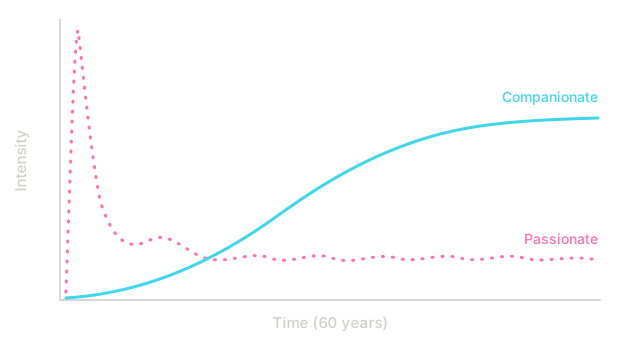
Passionate love spikes early and fades into a low hum; companionate love builds slowly over decades into a steady, higher plateau.
Related Experiment
Neural correlates of long-term intense romantic love
Observations: In early-stage couples, brain activity spiked cortisol and dopamine. In late-stage couples, it triggered opioid circuits related to safety and calm.
Danger Points When Transitioning from Passionate to Companionate Love
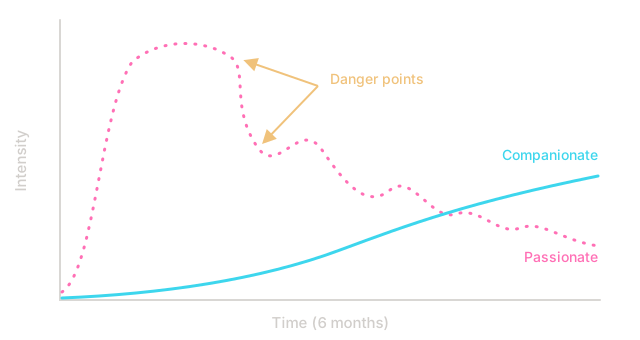
Passionate love spikes and crashes; companionate love builds slowly. The danger points sit right at the peak, and right after the first crash.
Based on The Happiness Hypothesis
- Peak of passionate love — at this phase, people tend to make drastic decisions, like proposing marriage or making unrealistic promises. This leads you to make decisions you would otherwise not make in a sane state of mind.
- When passionate love is wearing off — at this phase, the obsessive high fades and people mistake it for a lack of chemistry. If a couple relied purely on physical attraction and novelty, they realize once the high fades that they don’t have shared values or a deep friendship. Many relationships break at this point.
If you can avoid these two danger points, you may transition into a deeper and more meaningful phase of the relationship: companionate love.
Learnings
- Delay big decisions and major commitments early on. Be a bit practical at the start.
- Invest in friendship early. Build shared goals, values, and respect, so when the high fades you still have something to hold on to.
- Understand that novelty fades after a certain time. Knowing that this drug will fade prepares you for something real. The thing that was so interesting at the start won’t be as novel after a year.